
In this article
The key idea
Structured invoices and authority reporting data serve different purposes. Taxora connects validation and delivery workflows; country, recipient and status define the specific setup.
An invoice has been created in the accounting system. The digital workflow is not necessarily complete: the recipient needs a particular format, a delivery route must be available, and the transaction may require additional reporting.
With Taxora, we connect these tasks with VAT-number validation and traceable records. A useful starting point is to separate two purposes: sending an invoice to a business partner and reporting transaction data to an authority. E-invoicing and e-reporting address those different tasks.
E-invoicing and e-reporting serve different purposes
E-invoicing describes exchanging invoices in a structured electronic format. Systems can process the invoice data rather than first extracting it from an image or a freely formatted document.
E-reporting concerns electronically submitting specified transaction or payment data to the responsible authority. Which information is relevant depends on the rules and circumstances of the transaction.
| Question | E-invoicing | E-reporting |
|---|---|---|
| What is exchanged? | A structured invoice | Specified reportable data |
| Which relationship is central? | Invoice issuer and recipient | Business and responsible authority |
| What must the workflow clarify? | Format, recipient and delivery | Data scope, reporting route and status |
The distinction is also described by the French tax authority. A business needs to assess its specific transactions to establish the obligations that apply.
A PDF alone does not establish a structured handover
Sending an invoice by email does not, by itself, establish that the required electronic format or delivery route was used. A human-readable representation and machine-processable data are different parts of a workflow.
Before choosing an integration, establish where invoice data originates, which fields already exist in a structured form, and which details are added only when a PDF is created. This baseline is often more useful than choosing a converter at the start.
What Taxora connects
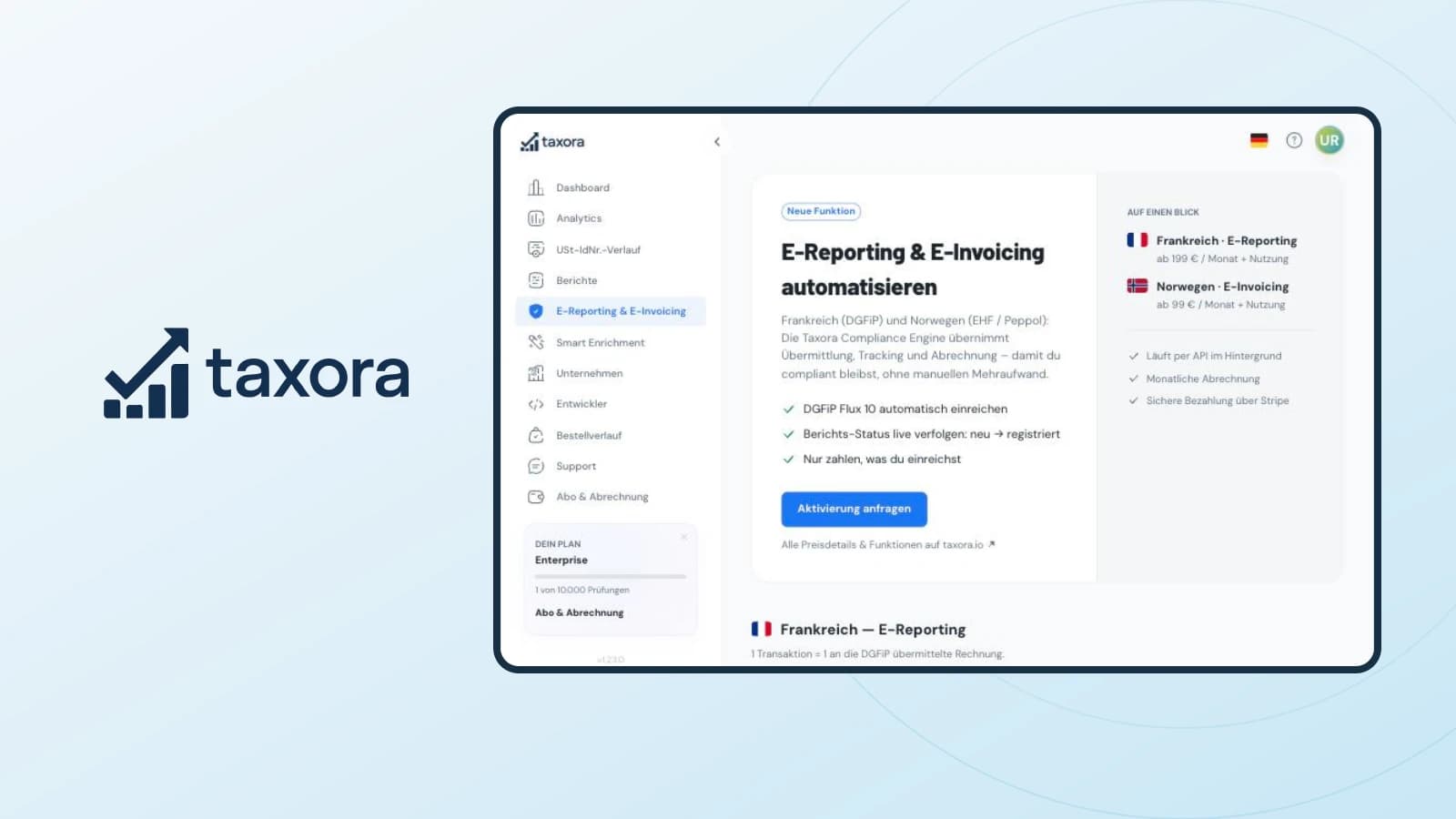
Taxora extends VAT validation with e-invoicing and e-reporting. Its public product description presents a shared API workflow: accept invoice data, check it, convert it into the intended country format and deliver it through the appropriate route. Delivery information and archiving are part of the described workflow.
Three handovers are particularly relevant for finance teams:
- Master data to validation: Connect business-partner and VAT details before further processing.
- Invoice data to delivery: Reuse a structured record rather than transferring information manually again.
- Request to traceable result: Associate status and evidence with the original operation.
Technical validation supports this process. It does not replace the accounting assessment of a transaction or responsibility for accurate input data.
France and Norway: Distinguish availability clearly
As of 22 October 2026, Taxora lists France and Norway as directly bookable. Other countries appear on request in its current country guide. An enquiry is not equivalent to an already activated connection.
For Norway, Taxora lists EHF 3.0 and delivery over Peppol. The Norwegian procurement authority explains the relationship between EHF invoices and the Peppol network.
For France, assess invoicing and reporting separately. The tax authority also explains the role of approved platforms. This does not establish that Taxora itself holds that status. The agreed service scope and actual delivery route matter when setting up the workflow.
Plan one connected process
A useful implementation sequence has five steps:
- Choose the source of truth: Identify whether ERP, commerce or accounting owns invoice and master data.
- Map requirements: Assess the country, recipient type and transaction, then record the information needed.
- Check data: Resolve missing or conflicting fields before submission.
- Track delivery: Connect the submitted data with a unique operation reference and its status.
- Handle exceptions: Give rejected, uncertain or corrected transactions a responsible owner.
This sequence also works for a phased introduction. A bounded pilot with representative invoices reveals data gaps before the complete record set is processed.
What happens after a failed submission?
A sent request and confirmed delivery are different states. When a response is missing, the workflow should not assume nothing happened. Before retrying, establish how the same operation is recognised and whether its status can be queried.
Test at least three cases before launch: missing required fields, interrupted transmission and a correction after an operation has already been processed. Who reviews the case, where is the decision recorded, and how does the corrected status reach the source system?
Our article on reliable API integrations explains the underlying planning questions.
From separate checks to a shared overview
The value for a finance team does not come from opening more systems. It comes from understanding the connection between a business partner, invoice, submission and outcome. Taxora brings VAT checks and additional finance workflows together in one product.
Our Taxora product page shows the original interface and other features. Consult Taxora’s guide for current country coverage and setup. Our API development work supports custom connections to existing systems.
Frequently asked questions
Does e-reporting replace an electronic invoice?
No. They serve different purposes. The requirements for a particular transaction determine which tasks apply.
Is every country on the map available immediately?
No. Taxora distinguishes directly bookable offerings from countries available on request. Check current status before planning an integration.
Can an existing accounting system remain in use?
An API integration can connect to existing systems. Data access, required fields, permissions and status feedback need assessment in the specific setup.
Does technical submission guarantee tax compliance?
No. Correct transaction classification and complete information remain substantive questions. The technical workflow and its records support that work.
Sources and review date
Reviewed on 22 October 2026. Product coverage and requirements can change. Implementation needs the current service scope and the requirements applicable to the specific transaction.