
In this article
The key idea
Time tracking needs to fit the workday. stemplr connects time, assignments and tasks to turn individual entries into a useful overview.
If you run a carpentry, metal workshop or small production team, you know the pain: time sheets are filled out late (or not at all), breaks are unclear, and nobody really trusts the numbers.
With stemplr, we set out to build a time tracking tool that fits the reality of craft businesses – simple enough for the shop floor, but powerful enough for management and accountants.
This challenge usually sits at the intersection of usability, compliance, and day-to-day operations. That is why time tracking in workshops works best when it is treated as product design plus workflow integration, not just another admin tool. Our stemplr product and product development services are built around that reality.
Why traditional time tracking fails in the workshop
Most tools are built for office workers. In a workshop environment, that simply doesn't work:
- People don't sit at desks all day
- Work is organised in jobs, machines and projects
- Break rules (e.g. mandatory 30-minute break after 6 hours in Austria) must be respected
- Internet connections can be unstable in production halls
The result: Employees forget to track, data quality is poor, and owners lose money because they don't see which projects are truly profitable.
stemplr: built around the workshop, not the other way around
stemplr focuses on a few things extremely well:
- A Kiosk Mode that runs on a tablet in the workshop
- Large buttons, clear project selection, and fast booking
- Configurable working-time and documentation features
- Reporting that shows exactly:
- Which employee worked how long
- On which project or machine
- And when
Instead of forcing people into complex menus, stemplr uses a central action approach: one clear entry point for "start work", "change task", "start break" and "clock out".
Keep understandable working-time records
Records should remain understandable after the working day. Clear allocations, documented breaks and regular review of open entries help. Working-time and documentation features are configured around the business requirements.
Reports and exports support handover to accounting or payroll. Agree on the required fields and formats before the first handover. Appropriate rules and complete information remain part of the business process.
Web, app and kiosk: One workflow across workplaces
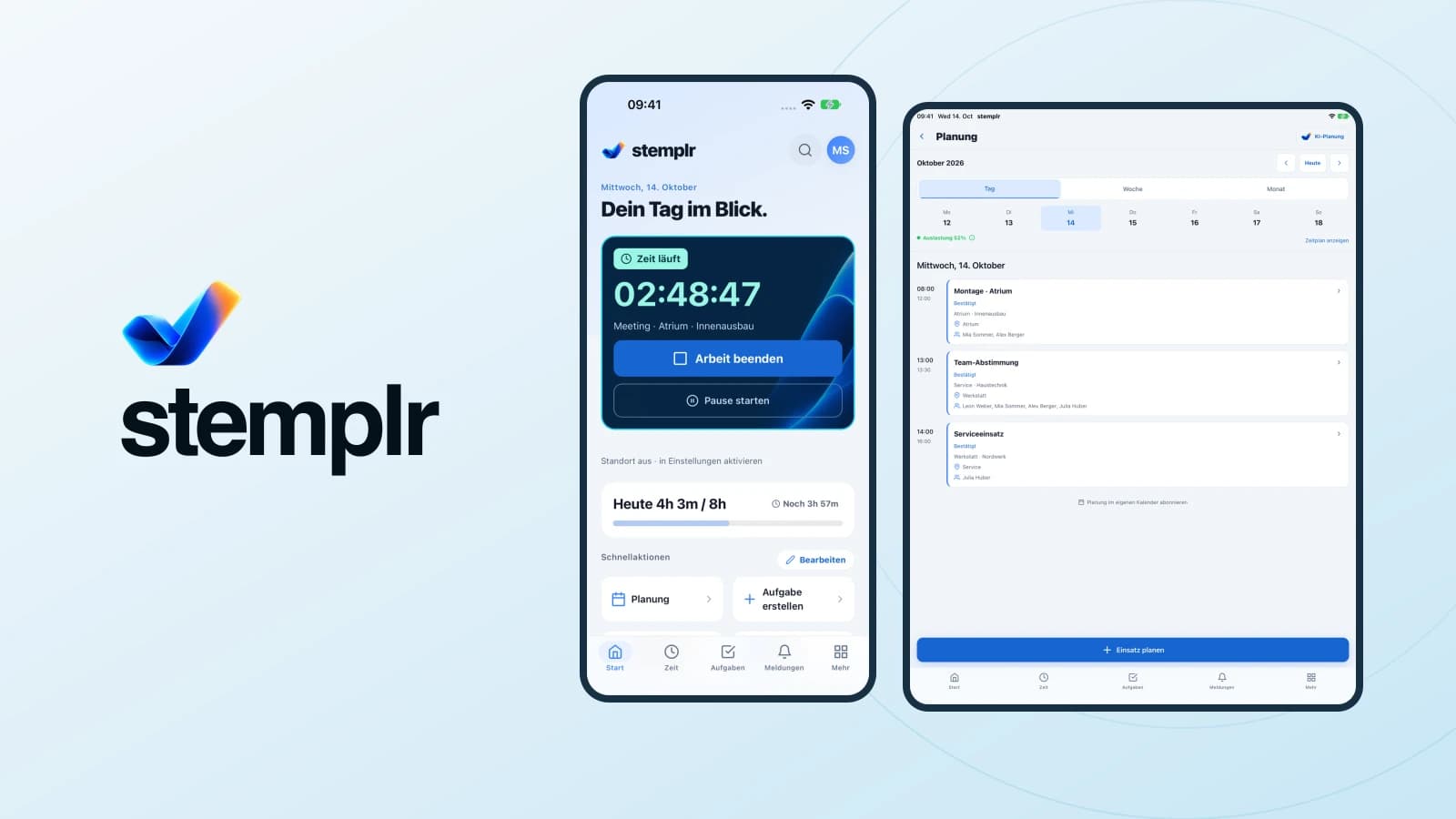
stemplr is available on the web, in the app and at a shared kiosk. A business does not need to choose the same device for every workplace. A shared workshop tablet, mobile tracking in the field and web access for administration can support the same process.
Agree on the rules as part of introduction: when to record breaks, how to allocate work to projects and who resolves a missing entry. An app supports that process; it does not replace the agreement.
Plan assignments and tasks together
The current planning view connects day, week and month views with specific assignments. Team members, location and status appear alongside the task. That connects the work planned with the time eventually recorded.
For daily operation, this means:
- Give orders and activities recognisable names.
- Agree on responsibilities and locations.
- Review planned and recorded work together.
- Resolve open questions before the next report.
Useful reporting depends on consistent inputs. Our API development work can help connect additional systems when a business needs a custom integration.
FAQ
Why do workshop teams struggle with traditional time tracking tools?
Most tools are designed for desk-based work, while workshops need fast interaction, shared devices, and project or machine-based bookings.
Can time tracking also help with compliance?
Yes. A good system can enforce break rules, surface risky shift patterns, and preserve records that are useful during audits or payroll reviews.
What makes adoption easier on the shop floor?
Simple interfaces, quick login methods, shared kiosk setups, and workflows that match how people already move through the day.
From raw hours to real insights
Once data quality is high, you can start asking better questions:
- Which type of projects are truly profitable?
- Where do we lose the most time – setup, production, rework?
- How much machine time do we need next year?
stemplr helps you get there by:
- Allocating recorded time to projects or orders
- Providing exportable reports for controlling and tax advisors
- Bringing assignments, tasks and responsible team members into one shared overview
Conclusion: Time tracking your team will actually use
For craft businesses, digitalisation only works if the tools feel natural in the workshop.
stemplr focuses on:
- Usability for workers
- Traceable records for owners
- Clean data for finance and controlling
If you want to move from "gut feeling" and paper slips to data you can trust, stemplr is a good place to start.

Ready to try stemplr?
Experience time tracking that fits your workshop. Simple, clear, and insightful.
Go to App